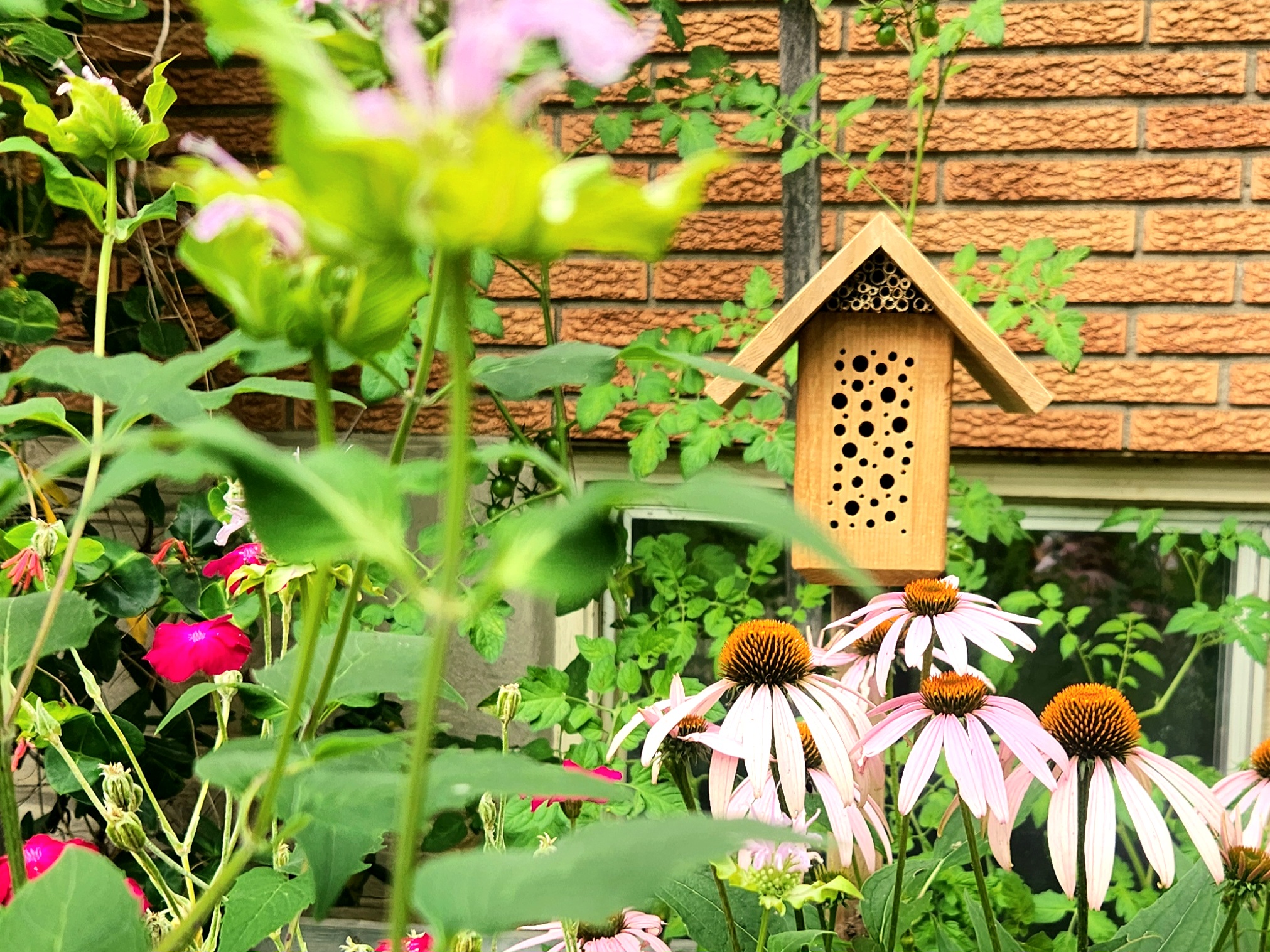
Unlike honey bees, solitary bees do not live together in colonies or hives. Instead, they can be either ground-nesting or cavity-nesting. Cavity-nesting bees raise their offspring in tunnels in wood or hollow plant stems. Solitary bees utilize holes that match their girth of 2 mm to 10 mm, depending on the species.
Solitary bees are important pollinators of both wild and cultivated plants. We have found that mason bees and leafcutter bees are the most common bees nesting in our baby bee bungalows.
You can welcome solitary bees to your garden with our HBRC Baby Bee Bungalows! Each Bee B&B is fitted with holes and phragmite stems for solitary bees to nest in. Visit our online store here or visit us in person to purchase a baby bee bungalow.